
In the microscopic domain, evolutionary success is fundamentally linked to a bacterium’s capacity for directed movement. Whether navigating toward optimal nutrient gradients (positive chemotaxis) or retreating from lethal chemical stressors (negative chemotaxis), motile prokaryotes rely on specialized, macromolecular appendages known as flagella.
While the core biochemical architecture of the bacterial flagellum remains highly conserved across domains, the spatial distribution and density of these structures across the cell envelope vary profoundly. These configurations are not phenotypic anomalies; they represent highly specialized evolutionary adaptations that dictate the hydrodynamic efficiency, torque generation, and environmental compatibility of specific bacterial species.
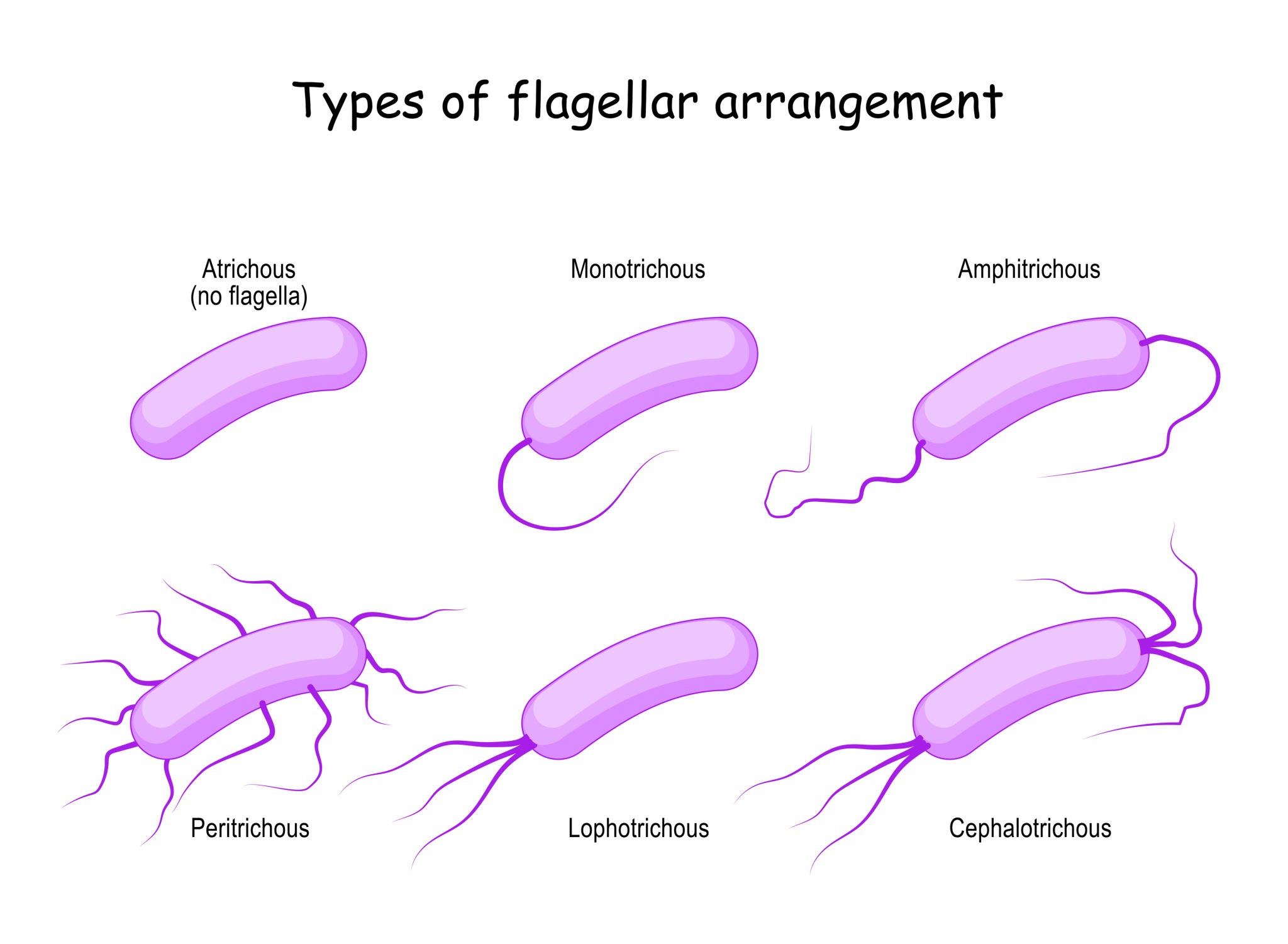
This text provides a rigorous structural, mechanical, and ecological analysis of the three primary polar flagellar arrangements: monotrichous, amphitrichous, and lophotrichous.
1. Ultrastructure and Thermodynamic Propulsion
To understand how variations in flagellar distribution influence cellular kinetics, one must first analyze the fundamental biophysical mechanism common to all bacterial flagella. Unlike the undulating, ATP-driven flagella of eukaryotic cells, the prokaryotic counterpart operates as a rigid, rotatory propeller driven by a transmembrane electrochemical gradient.
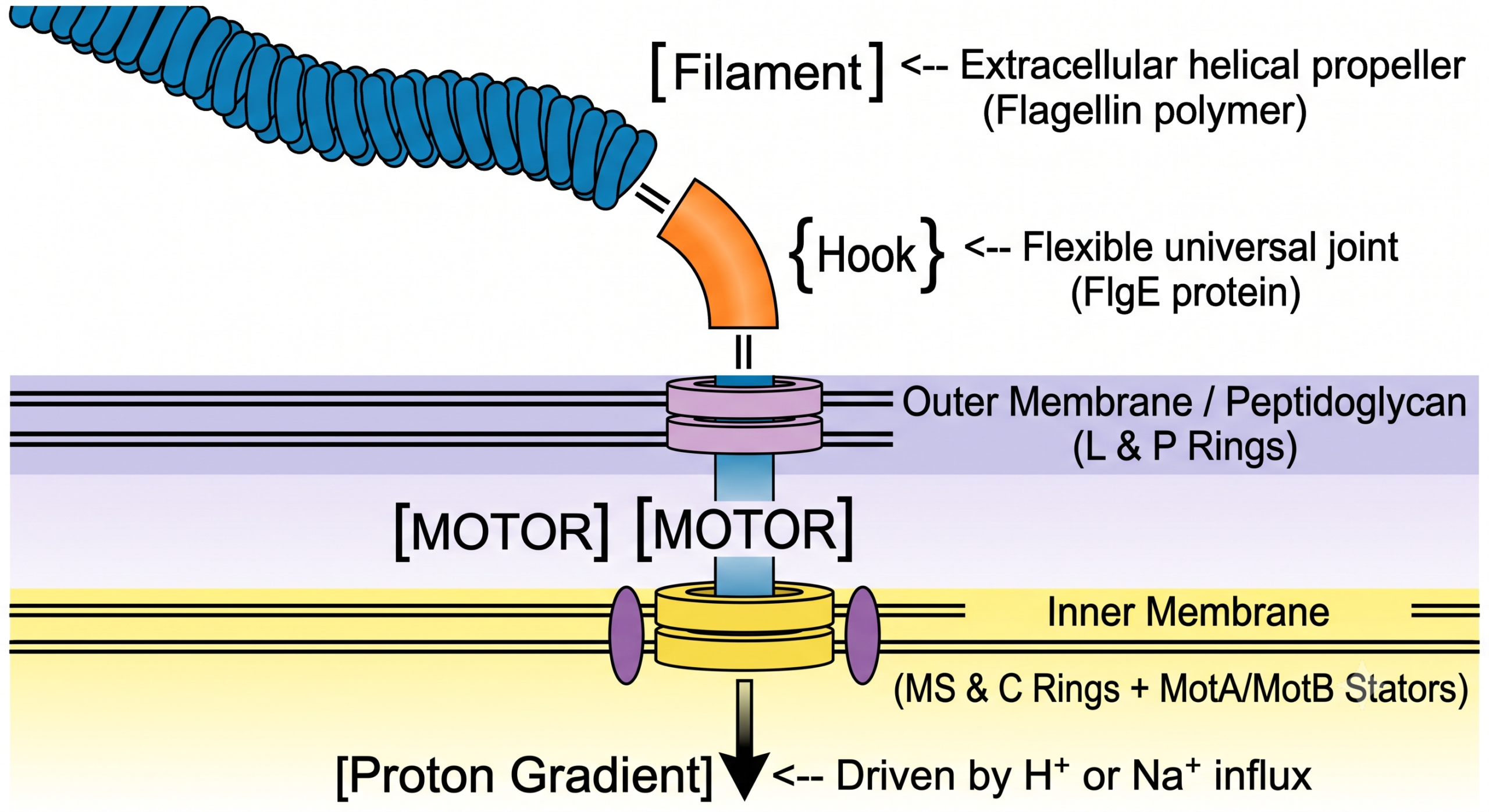
The flagellar apparatus is divided into three functional domains:
- The Basal Body: Functioning as a reversible rotary motor, the basal body is embedded within the plasma membrane and cell wall peptidoglycan. It consists of a central rod surrounded by a series of rings (L, P, MS, and C rings) that act as bushings and rotors. Propulsion is driven by the influx of protons (H+) or sodium ions (Na+) through stationary channel proteins (MotA and MotB stators), converting electrochemical potential into mechanical torque.
- The Hook: Composed of the protein FlgE, this flexible, curved structure extends just beyond the outer membrane. It acts as a universal joint, translating the high-speed rotational energy of the basal body into the long extracellular filament.
- The Filament: A hollow, rigid cylinder composed of thousands of repeating subunits of the protein flagellin (FliC). The helical geometry of the filament allows it to function as a macroscopic screw propeller, generating forward thrust when rotated.
2. Monotrichous Flagellation: The Unitary Polar Propeller
The monotrichous configuration represents the leanest iteration of polar flagellation. Derived from the Greek monos (single) and thrix (hair), this arrangement is characterized by a solitary flagellum positioned at a single pole of a rod-shaped bacterium.
Kinematics and Reorientation Dynamics
Monotrichous organisms operate via a highly dynamic “run-reverse-flick” or “run-and-reverse” swimming pattern. Because the cell relies on a single propulsion source, directionality is governed strictly by the rotational direction of the basal motor:
- Counterclockwise (CCW) Rotation: When the motor spins CCW, the helical filament pushes the cell body forward, driving a linear, high-velocity trajectory known as a “run.”
- Clockwise (CW) Rotation: Reversing the motor to a CW orientation pulls the cell backward. In many monotrichous species, the sudden transition from traction to compression induces a mechanical instability within the flexible hook. This causes the hook to buckle, initiating a rapid, asymmetrical “flick” that reorients the cell body by a random angle before the next CCW forward run begins.
Hydrodynamic Trade-Offs
From a fluid dynamics perspective, the monotrichous design minimizes drag coefficient. Lacking auxiliary filaments, the cell experiences negligible hydrodynamic interference, allowing it to achieve exceptional velocities in low-viscosity aqueous mediums.
However, this structural minimalism compromises maneuverability. The random nature of the hook-buckling mechanism means that steering is stochastic rather than precisely controlled, requiring the cell to execute multiple run-and-flick cycles to achieve precise alignment with a nutrient source.
3. Amphitrichous Flagellation: The Bipolar Axis
The amphitrichous topology (amphi-, meaning both or dual) features flagellar machinery localized at both opposing poles of the bacterial cell. This setup can manifest either as a single flagellum at each terminus or as discrete polar tufts.
Mechanical Coordination
The defining characteristic of amphitrichous motility is the functional alternation between the two poles. To prevent counterproductive kinetic forces, the motors at each end do not operate symmetrically; instead, they operate in a coordinated, push-pull tandem:
- Directional Advancement: The flagellar motor at the posterior terminus rotates in a manner that allows its filament to extend outward and act as a pusher. Concurrently, the motor at the anterior terminus either ceases rotation—allowing its filament to trail passively alongside the cell body to minimize resistance—or rotates in a direction that pulls the cell forward.
- Axial Reversal: To alter its path, the bacterium undergoes a rapid physiological shift, reversing the functional roles of both poles. The previous anterior flagellum assumes active propulsion, while the posterior flagellum transitions to a passive or pulling state. This allows the cell to execute instantaneous 180-degree axial reversals without undergoing a physical turn radius.
Niche Adaptation
Amphitrichous bacteria are evolutionarily optimized for highly constrained, microfluidic microenvironments. In narrow architectural spaces—such as deep soil capillary channels, aquatic sediments, or intercellular junctions within host tissues—horizontal turning space is severely restricted. The capacity to reverse axial direction cleanly makes this configuration highly advantageous for navigating complex subterranean or internal biological matrices.
4. Lophotrichous Flagellation: The Multi-Engine Polar Cluster
The lophotrichous configuration (lophos, meaning tuft or crest) involves a cluster of multiple flagella originating from a single localized point or pole on the cellular envelope.
Hydrodynamic Cohesion and Bundle Synchronization
The movement of a lophotrichous bacterium depends entirely on the fluid mechanical synchronization of its multiple filaments. When the individual basal motors are activated simultaneously in a counterclockwise direction, a unique aerodynamic phenomenon occurs:
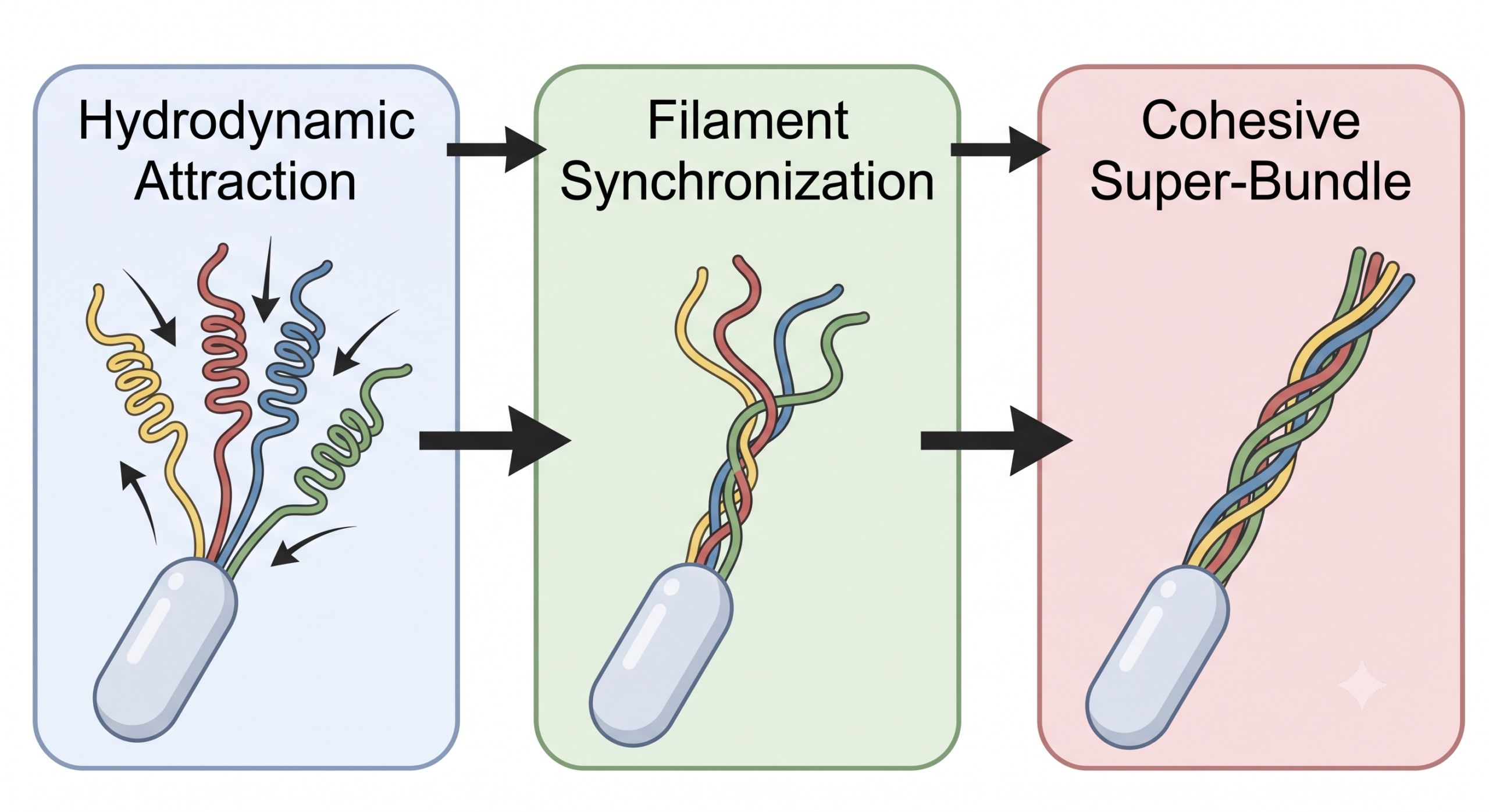
As the individual flagella rotate, the localized fluid flow generated by each filament pulls the neighboring filaments toward one another. Within milliseconds, this hydrodynamic attraction forces the splayed filaments to intertwine and lock into a singular, thick, cohesive “super-bundle.” This bundle acts as a single large propeller, producing immense forward thrust and driving the cell through high-viscosity mediums.
To alter course, the motors briefly shift to a clockwise rotation. This causes the super-bundle to untwist and splay outward in all directions—an event known as a “tumble.” The random orientation of the splayed filaments stops forward momentum and causes the cell to rotate erratically in place, establishing a new trajectory for the next bundle synchronization.
Kinetic Advantages
The primary advantage of the lophotrichous architecture is high torque generation. The combined mechanical output of multiple synchronized motors allows these bacteria to generate sufficient force to overcome severe viscous drag. This makes the configuration highly effective for burrowing through dense, gel-like macromolecular networks—such as physiological mucus membranes—that would instantly stall a single monotrichous flagellum.
5. Comparative Matrix of Polar Flagellar Systems
The following structural matrix isolates the key biophysical, mechanical, and ecological variables that differentiate the three polar flagellar topologies.
Structural Matrix of Polar Flagellar Topologies
| Diagnostic Parameter | Monotrichous Configuration | Amphitrichous Configuration | Lophotrichous Configuration |
| Numerical Density | Unitary (1) | Dual (2, or two discrete clusters) | Multiple (3–10+ typical) |
| Spatial Polarization | Monopolar | Bipolar | Monopolar Cluster |
| Kinetic Mechanism | Run-reverse-flick | Coordinated alternate pushing | Filament bundling and splaying |
| Torque Specification | Minimal | Intermediate | Maximum |
| Viscous Penetration | Ineffective (Prone to stalling) | Moderate efficiency | High efficiency (Excellent torque) |
| Fluidic Drag Profile | Lowest aerodynamic profile | Moderate drag profile | Highest drag profile during tumble |
| Steering Precision | Stochastic (Random hook buckling) | Direct axial reversal (180°) | Reorienting via bundle disruption |
| Representative Taxa | Vibrio cholerae, Pseudomonas aeruginosa | Campylobacter jejuni, Spirillum volutans | Helicobacter pylori, Pseudomonas fluorescens |
6. Biophysical Implications in Pathogenesis and Virulence
The physical arrangement of flagella influences more than just basic survival in the wild; it plays a critical role in the mechanical interactions between pathogenic bacteria and host organisms during infection cycles.
Mucosal Barrier Penetration
The primary line of defense in mammalian internal cavities is the mucosal barrier—a highly cross-linked, viscous gel composed of mucin glycoproteins.
Monotrichous organisms, while swift in open aqueous phases, often lack the physical force required to pierce dense mucus layers.
In contrast, lophotrichous pathogens like Helicobacter pylori leverage their multi-flagellar clusters to generate high mechanical torque. This physical force, combined with the enzymatic liquefaction of mucus via urease production, allows the pathogen to drill through the thick gastric mucous blanket and colonize the underlying epithelial surface, shielded from stomach acid.
Mechanosensation and Biofilm Initiation
Flagella also function as sophisticated mechanosensors. When a swimming bacterium encounters a solid surface, the sudden physical resistance stalls the flagellar motor. This inhibition of rotation halts the interior proton flux, altering the membrane potential.
In lophotrichous and amphitrichous species, this mechanical feedback loop is highly amplified due to the involvement of multiple motors. The resulting cellular signal triggers an immediate transcriptomic shift, downregulating flagellar synthesis genes and upregulating the production of sticky extracellular polymeric substances (EPS), initiating the formation of a biofilm.
References
- Madigan, M. T., Martinko, J. M., Bender, K. S., & Buckley, D. H. (2015). Brock Biology of Microorganisms (14th ed.). Pearson. Brock Biology of Microorganisms
- Lauga, E. (2016). Bacterial Hydrodynamics. Annual Review of Fluid Mechanics, 48(1), 105-130. Annual Review of Fluid Mechanics
- Duan, Q., Zhou, M., Zhu, X., & Zhu, G. (2013). Flagella and bacterial pathogenicity. Journal of Medical Microbiology, 62(Pt 1), 1-8. Journal of Medical Microbiology via Microbiology Society
- Kim, M., & Powers, T. R. (2004). Hydrodynamic interactions between helical flagella. Physical Review E, 69(6), 061910. Physical Review E via APS