
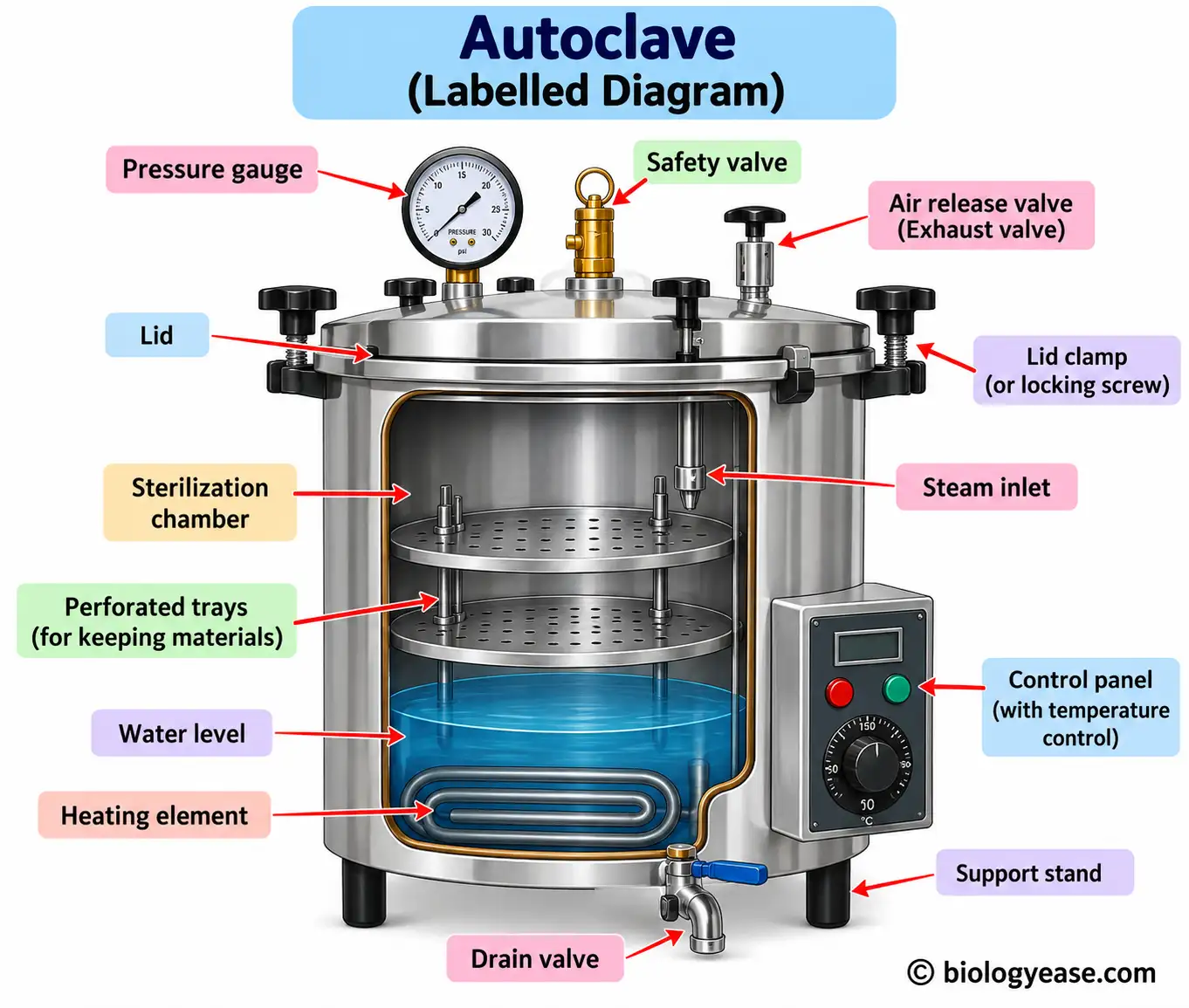
An autoclave is a laboratory instrument used for sterilization by exposing materials to saturated steam under pressure. It is widely used in microbiology laboratories, hospitals, pharmaceutical industries and research institutions to destroy microorganisms, including highly resistant bacterial endospores.
A commonly taught autoclave sterilization condition is 121°C at approximately 15 psi gauge pressure for 15–20 minutes, although the actual exposure time depends on the type, size and packaging of the load. Some materials require considerably longer sterilization cycles.
Autoclaving is one of the most dependable methods of moist heat sterilization because steam transfers heat efficiently and penetrates suitable materials.
In this article, we will discuss the principle of autoclave, working mechanism, construction, temperature, pressure, types, applications, advantages and disadvantages in detail.
What Is an Autoclave?
An autoclave is a sealed, pressure-resistant device designed to sterilize heat-stable materials using steam at temperatures above the normal boiling point of water.
Unlike ordinary boiling, which generally occurs at 100°C at sea level, an autoclave allows saturated steam to reach higher temperatures by increasing the pressure inside the sterilization chamber.
These conditions make it possible to inactivate bacteria, fungi, viruses and bacterial endospores when an appropriate validated sterilization cycle is used.
Autoclaves are commonly used to sterilize microbiological culture media, laboratory glassware, surgical instruments, dressings and certain biological wastes.
Principle of Autoclave
The principle of autoclave is moist heat sterilization using saturated steam under pressure.
Under normal atmospheric pressure, water boils at approximately 100°C. However, increasing the pressure within a sealed chamber raises the boiling point of water, allowing saturated steam to reach temperatures such as 121°C or 134°C.
When saturated steam contacts a cooler material, it condenses and releases latent heat. This heat rapidly raises the temperature of the material and destroys microorganisms through irreversible denaturation and coagulation of proteins, including essential microbial enzymes.
The effectiveness of autoclave sterilization depends on four important factors:
- Steam: Saturated steam must contact the surfaces requiring sterilization.
- Temperature: Sufficient heat must be achieved to inactivate microorganisms.
- Pressure: Pressure permits saturated steam to attain temperatures above 100°C.
- Exposure time: The specified temperature must be maintained for an appropriate period.
An important concept is that pressure itself is not the main factor responsible for killing microorganisms. Instead, pressure makes it possible to generate the high-temperature saturated steam required for sterilization.
Why Is Moist Heat More Effective Than Dry Heat?
Moist heat transfers energy more efficiently than dry heat. When steam condenses on a surface, it releases a large amount of energy that helps microbial proteins denature quickly.
For example, moist heat sterilization commonly operates near 121°C, whereas dry heat sterilization typically requires higher temperatures and longer exposure periods.
For a detailed comparison, read our article on Hot Air Oven: Principle, Parts, Types and Uses.
Parts of an Autoclave and Their Functions
Although autoclaves vary in size and design, most laboratory steam sterilizers contain the following components.
| Part | Function |
|---|---|
| Sterilization chamber | Holds the materials being sterilized |
| Door or lid | Seals the chamber during operation |
| Pressure gauge or sensor | Measures chamber pressure |
| Temperature sensor | Monitors sterilization temperature |
| Safety valve | Protects against excessive pressure |
| Steam generator or heating element | Produces steam |
| Exhaust valve | Allows steam and air to leave the chamber |
| Trays or baskets | Hold materials while permitting steam circulation |
| Control panel | Controls the sterilization cycle |
| Door gasket | Maintains an airtight, pressure-resistant seal |
Sterilization Chamber
The chamber is generally constructed from corrosion-resistant stainless steel. It withstands high temperature and pressure while holding items during sterilization.
Pressure Gauge and Temperature Sensor
The pressure gauge indicates pressure within the chamber, while the temperature sensor measures sterilization temperature. Both parameters are important for monitoring equipment performance.
Safety Valve
The safety valve releases excess pressure when necessary and helps protect the instrument from dangerous pressure buildup.
Steam Generator
The steam generator heats water to produce the saturated steam used during sterilization. Some autoclaves receive steam from an external supply instead.
Working of Autoclave: Step-by-Step Process
The working of an autoclave involves air removal, steam generation, temperature elevation, sterilization and controlled cooling.
Step 1: Loading the Materials
Materials are placed in suitable autoclave-safe containers, trays or sterilization bags. They should be arranged to allow steam circulation.
The chamber must not be overloaded, as tightly packed materials may prevent steam from contacting all surfaces.
Step 2: Closing the Chamber
The autoclave door or lid is securely closed, and the appropriate sterilization program is selected according to the material being processed.
Step 3: Removing Air
Air must be removed from the chamber because trapped air can prevent saturated steam from contacting the load.
In gravity-displacement autoclaves, steam pushes air out through a drain or exhaust opening. In pre-vacuum autoclaves, a vacuum pump removes air before steam enters.
Step 4: Increasing Temperature and Pressure
Steam enters or forms inside the chamber. As air is removed and saturated steam pressure rises, the chamber reaches its programmed sterilization temperature.
For a conventional 121°C cycle, the corresponding saturated steam pressure is approximately 15 psi above atmospheric pressure.
Step 5: Sterilization or Exposure Phase
The materials are held at the specified sterilization conditions for the required exposure period.
During this phase, steam transfers heat to the materials and denatures vital microbial proteins, resulting in the destruction of microorganisms and sufficiently exposed bacterial spores.
The holding period is counted after the required sterilization conditions have been established, not simply when the machine is switched on.
Step 6: Exhaust and Cooling
After the sterilization phase, the machine reduces chamber pressure through a controlled process.
Liquids generally require slow exhaust and cooling cycles to prevent violent boiling, splashing or container breakage.
Step 7: Unloading the Materials
Once the cycle is complete and the equipment indicates safe conditions, the sterilized materials can be removed using appropriate personal protective equipment.
Operators should check the cycle record and required sterilization indicators before releasing the load for use.
Autoclave Temperature, Pressure and Time
The temperature and pressure of an autoclave are closely related because saturated steam reaches higher temperatures as its pressure increases.
The two commonly discussed sterilization temperature ranges are 121°C and 132–135°C.
| Temperature | Approximate saturated steam gauge pressure | Exposure time example |
|---|---|---|
| 115°C | 10 psi | Requires a validated material-specific cycle |
| 121°C | 15 psi | Common teaching example: 15–20 minutes for suitable small loads |
| 121°C | 15 psi | 30 minutes for wrapped healthcare supplies in certain gravity-displacement cycles |
| 132°C | 27 psi | 4 minutes for specified wrapped loads in certain pre-vacuum cycles |
| 134°C | 30 psi | Often several minutes in validated high-temperature cycles |
Important: These are illustrative conditions, not interchangeable operating instructions. The correct time depends on the autoclave, load size, packaging, air removal, required sterilization assurance and manufacturer-approved cycle.
Why Is 121°C and 15 psi Used in an Autoclave?
The combination of 121°C and approximately 15 psi gauge pressure is widely used because it allows water to form saturated steam at a temperature sufficient for effective microbial inactivation.
At 121°C, moist heat can destroy resistant bacterial spores when the correct exposure conditions are maintained.
The commonly quoted 15 psi is gauge pressure, meaning approximately 15 pounds per square inch above the surrounding atmospheric pressure. It is not 15 psi absolute pressure.
This distinction is important because steam temperature depends on absolute pressure.
Why Is 15 Minutes Not Always Sufficient?
A common misconception is that every material becomes sterile after exactly 15 minutes at 121°C.
In practice, the required exposure time depends on several factors:
- Type and quantity of materials.
- Volume of liquids.
- Initial microbial contamination.
- Presence of bacterial spores.
- Air removal and steam penetration.
- Container design and packaging.
- Validated sterilization cycle.
For example, a small quantity of suitable culture medium may be processed using a relatively short validated exposure period, while large liquid volumes, wrapped instruments and biological waste may require substantially longer cycles.
Types of Autoclaves
Autoclaves can be classified according to their design and method of removing air from the sterilization chamber.
1. Gravity Displacement Autoclave
In this type, steam enters the chamber and displaces the air through an exhaust or drain opening.
Gravity-displacement autoclaves are commonly used for certain laboratory media, glassware and compatible equipment.
2. Pre-Vacuum Autoclave
A pre-vacuum autoclave uses a vacuum pump to remove air before introducing steam.
This allows more effective steam penetration into suitable porous and wrapped loads and can reduce required exposure times in validated cycles.
3. Vertical Autoclave
A vertical autoclave has an upright cylindrical chamber with a lid at the top.
It is commonly used in educational institutions and smaller microbiology laboratories.
4. Horizontal Autoclave
A horizontal autoclave has a chamber that is loaded through a front door.
These systems are often used in hospitals, centralized sterilization departments and larger laboratories.
5. Tabletop Autoclave
A tabletop autoclave is a compact steam sterilizer designed for smaller facilities, laboratories and clinical settings. Its capabilities depend on its cycle classification and manufacturer’s instructions.
Uses of Autoclave in Microbiology
An autoclave is an essential instrument in microbiology because contamination can interfere with microbial cultivation, identification and experimental results.
1. Sterilization of Culture Media
Autoclaves are widely used to sterilize heat-stable culture media, including many nutrient agar and nutrient broth formulations.
This helps prevent unwanted microorganisms from growing in the prepared media.
Autoclaving is also important in fermentation processes, where contamination can affect microbial productivity. Learn more in our article on Fermentation Media.
2. Sterilization of Laboratory Glassware
Borosilicate glassware, including certain test tubes, flasks and bottles, can be autoclaved when designed for steam sterilization.
Materials should be positioned correctly to allow steam penetration and avoid breakage.
3. Sterilization of Surgical Instruments
Many reusable stainless-steel surgical instruments are suitable for steam sterilization, provided they are compatible with the manufacturer’s validated instructions.
4. Decontamination of Microbiological Waste
Autoclaves are used to treat certain contaminated cultures, laboratory waste and other biological materials before disposal.
Waste sterilization often requires longer or specially validated cycles because steam penetration into densely packed waste can be difficult.
5. Sterilization of Dressings and Fabrics
Compatible surgical dressings, gowns and textile products can be processed using appropriate steam sterilization cycles.
6. Pharmaceutical and Biotechnology Applications
Autoclaves are used in pharmaceutical laboratories, quality-control facilities and biotechnology industries to sterilize compatible equipment, solutions and production materials.
7. Preparation of Contamination-Free Culture Conditions
Autoclaving helps reduce unwanted microbial contamination during the preparation of laboratory materials.
For example, sterile media and equipment are essential for several Biochemical Tests used in bacterial identification.
What Cannot Be Autoclaved?
Not all laboratory materials can withstand high temperatures, pressure and moisture.
Materials generally unsuitable for autoclaving include:
- Flammable liquids and organic solvents.
- Volatile or corrosive chemicals.
- Bleach-containing and incompatible oxidizing solutions.
- Heat-sensitive plastics without autoclave approval.
- Electronic instruments not designed for steam sterilization.
- Oils, powders and water-sensitive substances requiring other validated methods.
- Certain antibiotics, vitamins and other heat-labile biological compounds.
Heat-sensitive solutions may require membrane filtration or another suitable sterilization method.
Advantages of Autoclave
- Provides highly effective sterilization when the correct cycle is used.
- Can destroy resistant bacterial endospores.
- Uses steam rather than toxic sterilizing chemicals.
- Offers efficient heat transfer and penetration.
- Is suitable for many laboratory and healthcare materials.
- Can process numerous items within one cycle.
- Supports monitoring through physical, chemical and biological indicators.
Disadvantages of Autoclave
- Cannot be used for many heat-sensitive materials.
- Moisture can damage certain instruments and substances.
- Improper operation can cause steam burns and pressure-related injuries.
- Large loads and liquids may require lengthy cycles.
- Incorrect loading can prevent effective steam penetration.
- Requires regular maintenance, validation and monitoring.
Precautions While Using an Autoclave
Autoclaves operate at high temperature and pressure, so proper laboratory safety procedures are essential.
- Inspect the instrument and follow its approved operating procedure.
- Use containers and packaging specifically suitable for autoclaving.
- Do not overload the chamber.
- Avoid tightly sealing containers containing liquids.
- Keep incompatible chemicals out of the autoclave.
- Select the correct validated cycle for the load.
- Use suitable sterilization indicators according to the laboratory’s quality-control requirements.
- Never attempt to open the chamber while it remains pressurized.
- Allow liquids and materials to cool before handling.
- Wear suitable heat-resistant gloves, protective clothing and eye or face protection.
Autoclave Sterilization Indicators
Sterilization indicators help assess whether an autoclave cycle has performed as expected.
Physical Indicators
Physical monitoring records sterilization parameters such as temperature, pressure and time.
Chemical Indicators
Chemical indicators undergo a visible change when exposed to specified processing conditions.
Autoclave tape is a common example, but a tape color change alone does not prove that the entire load is sterile.
Biological Indicators
Biological indicators are used to evaluate the effectiveness of the sterilization process using highly resistant microorganisms.
Geobacillus stearothermophilus spores are commonly used as biological indicators for steam sterilization because of their high resistance to moist heat.
The relevance of these resistant structures becomes clearer when studying Bacterial Endospores: Structure, Components and Sporulation.
Difference Between Autoclave and Hot Air Oven
Both autoclaves and hot air ovens are used for sterilization, but they operate through different methods of heat transfer.
| Feature | Autoclave | Hot Air Oven |
|---|---|---|
| Sterilization method | Moist heat | Dry heat |
| Sterilizing medium | Saturated steam | Hot air |
| Typical temperature | 121–134°C | 160–180°C |
| Pressure | Pressurized chamber | Usually atmospheric pressure |
| Heat transfer | Highly efficient steam condensation | Convection and conduction |
| Relative exposure time | Generally shorter | Generally longer |
| Suitable materials | Media, compatible instruments, dressings | Dry glassware, some metals, powders and oils |
| Main limitation | Unsuitable for moisture-sensitive materials | Slower heat penetration |
Frequently Asked Questions About Autoclave
1. What is the principle of autoclave?
An autoclave works on the principle of moist heat sterilization using saturated steam under pressure. Steam destroys microorganisms primarily by denaturing and coagulating essential proteins.
2. What is the standard temperature of an autoclave?
A commonly used sterilization temperature is 121°C, although many autoclaves also operate at higher temperatures, such as 132–135°C, depending on the cycle and application.
3. What is the standard pressure of an autoclave?
Approximately 15 psi gauge pressure is commonly associated with saturated steam at 121°C. Other sterilization temperatures require different pressures.
4. Why is 121°C used instead of 100°C?
Steam at 121°C provides greater microbial killing effectiveness than boiling water at 100°C, particularly against resistant bacterial endospores.
5. Can an autoclave kill bacterial spores?
Yes. A correctly performed and validated steam sterilization cycle can inactivate bacterial spores, including resistant endospores.
6. What is the difference between sterilization and disinfection?
Sterilization is a validated process intended to eliminate viable microorganisms, including bacterial spores, to the required sterility assurance level. Disinfection reduces or inactivates microorganisms but does not necessarily eliminate bacterial spores.
7. Which biological indicator is used in an autoclave?
Spores of Geobacillus stearothermophilus are widely used as biological indicators for monitoring steam sterilization effectiveness.
8. Is autoclaving suitable for all culture media?
No. Many heat-stable culture media can be autoclaved, but certain heat-sensitive components must be sterilized separately or added aseptically after cooling.
Conclusion
The autoclave is one of the most important sterilization instruments in microbiology and healthcare. It uses saturated steam under pressure to destroy microorganisms, including resistant bacterial endospores.
The commonly cited conditions of 121°C and 15 psi gauge pressure provide a useful foundation for understanding autoclave operation. However, effective sterilization requires correct air removal, steam penetration, exposure time and validated cycle selection.
Understanding the principle, working, parts, temperature, pressure and uses of an autoclave is essential for microbiology students and laboratory professionals.
References
- Centers for Disease Control and Prevention (CDC). Steam Sterilization.
- CDC. Sterilizing Practices and Monitoring.
- University of California San Diego. Autoclave Overview.
- University of Iowa. Autoclaving Guidelines.