
In bioprocess engineering, converting biological materials into market-ready therapeutic, commercial, or agricultural products requires two main phases: upstream processing and downstream processing. While upstream processing focuses on cell culture, cell line development, media optimization, and fermentation to yield a biological target, downstream processing is responsible for harvesting, isolating, purifying, and formulating that target into a safe and stable final product.
Whether manufacturing monoclonal antibodies (mAbs), vaccines, recombinant proteins, industrial enzymes, or bio-based chemicals, downstream processing accounts for up to 60% to 80% of total bioprocessing costs. Mastering these purification stages is essential for biopharmaceutical companies and bio-engineers seeking maximum yield, high purity, and scalable manufacturing workflows.
Define Downstream Processing (Definition & Overview)
Downstream processing definition: Downstream processing refers to the recovery, separation, purification, and formulation of biosynthetic products (such as proteins, antibodies, antibiotics, enzymes, vitamins, and nucleic acids) from natural sources such as animal tissues, plant tissues, or fermentation broths after upstream cell growth is complete.
When asking what is downstream processing, it helps to understand its overarching goal: transforming a complex biological mixture containing target molecules, host cell proteins (HCP), host cell DNA (hcDNA), cell debris, residual media components, and endotoxins into a highly purified, biologically active, and safe product.
Why is Downstream Processing Critical in Biotechnology?
- Regulatory Compliance: Biopharmaceuticals intended for human administration must meet strict purity thresholds (often >99% purity with endotoxin levels <0.25 EU/mL).
- Biological Activity: Proteins must retain their tertiary and quaternary folded structures to remain therapeutic and active.
- Economic Viability: Downstream operations are capital-intensive. Minimizing product loss across multi-stage purification steps directly determines process profitability.
- Safety & Immunogenicity: Impurities like DNA, viruses, and aggregate proteins can cause severe immunological responses in patients.
Upstream vs. Downstream Processing: Key Differences
Understanding downstream processing in biotechnology requires distinguishing it from upstream operations. The table below outlines the contrast across key bioprocessing parameters:
| Parameter | Upstream Processing | Downstream Processing |
|---|---|---|
| Primary Objective | Biological synthesis & expansion of biomass/target product. | Separation, purification, concentration, and formulation of the product. |
| Core Activities | Strain selection, media preparation, cell culture, bioreactor fermentation. | Centrifugation, filtration, cell lysis, chromatography, ultrafiltration, drying. |
| Input Material | Inoculum, nutrient media, oxygen, feed solutions. | Harvested cell culture broth (HCCB) or crude bioprocess mixture. |
| Output Material | Crude cell broth containing target product and complex impurities. | Purified, sterile, bulk active pharmaceutical ingredient (API) or final drug product. |
| Cost Contribution | 20% – 40% of overall bioprocess manufacturing cost. | 60% – 80% of overall bioprocess manufacturing cost. |
| Key Performance Metric | Titer (g/L), specific productivity, cell viability, volumetric yield. | Recovery yield (%), chromatographic purity (%), identity, endotoxin units. |
Comprehensive Downstream Processing Diagram
A typical bioprocess follows a sequential, four-tier operational architecture. Below is a detailed downstream processing diagram representing standard operations from crude cell broth to the final formulated product:
FERMENTATION / HARVEST BROTH (Upstream Output)
STEP 1: REMOVAL OF INSOLUBLES (Solid-Liquid Separation)
- Centrifugation / Continuous Disc-Stack Centrifugation
- Microfiltration / Depth Filtration
- Cell Lysis (High-Pressure Homogenization if product is Intracellular)
STEP 2: ISOLATION OF PRODUCT (Concentration)
- Ultrafiltration / Tangential Flow Filtration (TFF)
- Precipitation (Ammonium Sulfate / PEG)
- Liquid-Liquid Extraction / Aqueous Two-Phase Extraction (ATPE)
STEP 3: HIGH-RESOLUTION PURIFICATION
- Affinity Chromatography (e.g., Protein A for mAbs)
- Ion-Exchange Chromatography (AEX / CEX)
- Hydrophobic Interaction Chromatography (HIC) / Size Exclusion (SEC)
STEP 4: PRODUCT POLISHING & FORMULATION
- Virus Clearance / Nanofiltration / Inactivation
- Diafiltration & Excipient Addition (Buffer Exchange)
- Lyophilization (Freeze Drying) or Sterile Bulk Storage
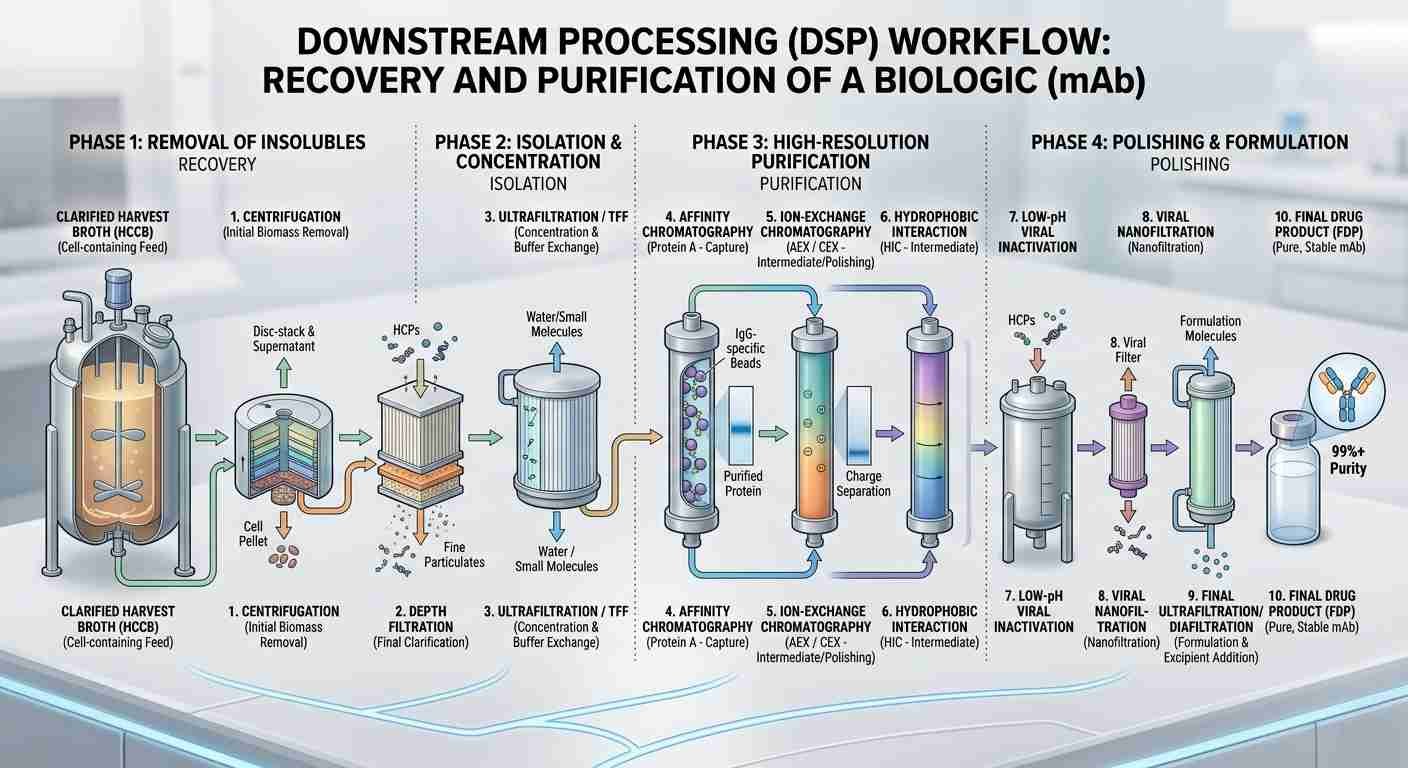
The 4 Main Downstream Processing Steps
The standard execution of downstream processing steps relies on the RIPP scheme: Removal of insolubles, Isolation of products, Purification, and Polishing. Below is an in-depth breakdown of each individual phase.
Step 1: Removal of Insolubles (Solid-Liquid Separation)
The primary objective of the first step is to clear particulate matter and separate intact cells, cellular debris, and insoluble precipitates from the aqueous phase.
A. Extracellular vs. Intracellular Target Separation
- Extracellular Products: If the cell secretes the product into the growth medium (e.g., CHO cell culture producing mAbs), the biomass is removed, and the liquid filtrate (supernatant) containing the product is collected.
- Intracellular Products: If the product remains inside the organism (e.g., E. coli expressing inclusion bodies), the cells are harvested, concentrated, and subjected to cell lysis (high-pressure homogenization, microfluidization, or enzymatic treatment with lysozyme) to break open the cell wall and release intracellular contents.
B. Primary Separation Equipment
- Continuous Centrifugation: Disc-stack centrifuges and decanter centrifuges use centrifugal force to separate dense cellular mass from liquid medium at scale.
- Depth Filtration: Microporous tortuous path filters trap fine particulates, cell fragments, and colloidal matter that escape centrifugation.
- Microfiltration: Tangential flow microfiltration membranes (0.1 µm – 0.22 µm) isolate cells without blinding or cake buildup.
Step 2: Isolation of Product / Concentration
Following insoluble removal, the harvest liquid contains the product along with vast quantities of water, media components, dissolved salts, and non-target proteins. The second step aims to reduce volume and remove major non-proteinaceous contaminants.
Key Isolation Technologies
- Ultrafiltration (UF) / Tangential Flow Filtration (TFF): Uses semi-permeable membranes with defined Molecular Weight Cut-Off (MWCO) ratings (e.g., 10 kDa, 30 kDa). Water and small solutes pass through as permeate while target proteins are retained and concentrated.
- Precipitation: Adjusting salt concentrations (e.g., ammonium sulfate precipitation / salting-out), adding non-ionic polymers (PEG), or altering pH/temperature causes target proteins or contaminant proteins to selectively precipitate.
- Liquid-Liquid & Solvent Extraction: Frequently employed for small molecules, antibiotics (e.g., penicillin isolation using butyl acetate), and lipophilic secondary metabolites.
- Adsorption: Batch adsorption using hydrophobic or ion-exchange resins to capture low-concentration target molecules directly from clarified broths.
Step 3: High-Resolution Purification
The third phase isolates the target product from closely related chemical and biological impurities, including host cell proteins (HCP), host cell DNA (hcDNA), viral particles, and product variants (e.g., misfolded structures or truncated fragments). Preparative Chromatography is the dominant method used during this stage.
Chromatography Methods in Downstream Processing
| Chromatography Mode | Basis of Separation | Common Application |
|---|---|---|
| Affinity Chromatography (AC) | Specific bioaffinity interactions (e.g., receptor-ligand, antibody-antigen). | Protein A / Protein G chromatography for capture of Monoclonal Antibodies (mAbs). |
| Anion Exchange (AEX) | Charge interaction (binds negatively charged target/impurities to positive matrix). | Clearance of negatively charged host cell DNA, endotoxins, and viruses. |
| Cation Exchange (CEX) | Charge interaction (binds positively charged target/impurities to negative matrix). | Intermediate purification and separation of charge variants of target proteins. |
| Hydrophobic Interaction (HIC) | Reversible hydrophobic interactions between non-polar regions and hydrophobic ligands. | Separation of correctly folded proteins from aggregates and misfolded species. |
| Size Exclusion (SEC) | Hydrodynamic volume / Molecular weight difference (molecular sieving). | Desalting, buffer exchange, and removal of high-molecular-weight aggregates. |
Step 4: Product Polishing and Formulation
The final phase converts the purified intermediate into a stable, drug-grade or commercial-grade product ready for packaging.
Polishing & Finishing Operations
- Viral Inactivation and Retentive Filtration: Critical in biopharmaceutical processing. Involves low-pH treatment (pH 3.5 for 30–60 mins) or detergent exposure to disrupt enveloped viruses, followed by viral nanofiltration (15–20 nm membrane filters) to physically retain non-enveloped viral particles.
- Final Diafiltration & Buffer Exchange: Tangential Flow Ultrafiltration replaces purification buffers with the final formulation buffer containing stabilizing excipients (e.g., trehalose, polysorbate-20, histidine).
- Sterile Filtration: Passing the liquid product through a 0.22 µm membrane filter in a Class A / ISO 5 cleanroom environment to eliminate microbial contamination.
- Lyophilization (Freeze-Drying): Used for labile biologic drugs prone to hydrolytic degradation. Removes ice via sublimation under vacuum to yield a dry cake with extended shelf-life.
Downstream Processing in Fermentation
When analyzing downstream processing in fermentation, industrial bioprocess engineers categorize operations based on whether the microbial culture produces primary/secondary metabolites, bulk industrial enzymes, or biopharmaceuticals.
Fermentation Product Classification & Purification Vectors
Downstream recovery from fermentation broths depends on product properties:
- Volatile Organic Solvents (e.g., Bioethanol, Acetone, Butanol): Purified primarily via multi-stage fractional distillation and pervaporation.
- Organic Acids (e.g., Citric acid, Lactic acid): Recovered via calcium salt precipitation, reactive extraction, or electrodialysis.
- Antibiotics (e.g., Penicillin, Streptomycin): Extracted from filtered broth using liquid-liquid organic solvent extraction followed by crystallization.
- Recombinant Intracellular Enzymes (e.g., Taq Polymerase): Requires cell wet-paste harvesting, mechanical bead-milling or homogenization, nucleic acid removal via polyethyleneimine (PEI), and ion-exchange capture.
Key Unit Operations and Equipment Comparison
Selecting the proper unit operation balances capital expenditure (CapEx), operating expenses (OpEx), processing speed, yield loss, and product stability.
| Unit Operation | Primary Application | Key Advantage | Limitation / Drawback |
|---|---|---|---|
| Disc-Stack Centrifuge | Primary clarification of high-density fermentation broths. | High volumetric throughput; continuous solids discharge. | High shear forces may lyse fragile mammalian cells. |
| Depth Filtration | Secondary clarification post-centrifugation. | High loading capacity; removes colloids and cell debris. | Single-use consumable cost; potential product binding. |
| High-Pressure Homogenizer | Intracellular cell disruption (bacteria/yeast). | Scalable; highly efficient cell wall disruption. | Heat generation requires active cooling; causes shear damage. |
| Affinity Chromatography | Primary capture step for monoclonal antibodies. | High specificity; yields >95% purity in a single step. | Expensive resin media; prone to fouling and ligand leaching. |
| Tangential Flow Ultrafiltration | Concentration and buffer exchange (diafiltration). | Gentle processing; high flux retention; scalable format. | Membrane fouling / concentration polarization over time. |
| Lyophilizer (Freeze Dryer) | Final formulation of therapeutic proteins & vaccines. | Provides long-term product stability at ambient/cold storage. | High energy consumption; slow batch cycle times (24–72 hours). |
Key Challenges and Optimization Strategies
Modern downstream bioprocessing faces structural bottlenecks driven by high expression yields in upstream bioreactors. As bioreactor titers exceed 5–10 g/L for mAbs, downstream operations experience severe processing bottlenecks.
1. Chromatographic Bottlenecks
Large column dimensions and expensive chromatography media (such as Protein A) create financial and throughput constraints. Engineers address this through Continuous Chromatography—such as Multi-Column Chromatography (MCC) or Simulated Moving Bed (SMB) systems—which increases resin capacity utilization and reduces buffer volume requirements by 30%–50%.
2. Viscosity and High Concentration Aggregation
Ultrafiltration of highly concentrated protein solutions (>100 mg/mL) increases solution viscosity, causing membrane fouling and protein aggregation. Strategies to mitigate this include optimizing ionic strength, integrating excipients during ultrafiltration, and utilizing high-shear TFF cassettes.
3. Transition to Single-Use Systems (SUS)
Traditional stainless-steel equipment requires extensive Cleaning-in-Place (CIP) and Steam-in-Place (SIP) validation. Transitioning to single-use downstream equipment—such as disposable depth filters, pre-packed chromatography columns, and single-use TFF assemblies—eliminates cross-contamination risks and reduces turnaround times between batches.
Frequently Asked Questions (FAQs)
Q1: What is the main difference between upstream and downstream processing?
A: Upstream processing involves cell growth, culture expansion, media optimization, and bioproduct synthesis in bioreactors. Downstream processing encompasses all operations required to harvest, isolate, purify, and formulate that synthesized product into a stable final drug or commercial chemical.
Q2: What are the 4 stages of downstream processing?
A: The 4 stages are based on the RIPP principle:
1. Removal of Insolubles (solid-liquid separation via centrifugation/filtration),
2. Isolation of Product (concentration via ultrafiltration/extraction),
3. Purification (high-resolution chromatography), and
4. Polishing (viral clearance, formulation, sterile filtration, and drying).
Q3: Why is downstream processing so expensive?
A: Downstream processing involves costly specialized materials—such as preparative affinity chromatography resins (e.g., Protein A), high-grade filtration membranes, single-use single-pass TFF systems, and rigorous analytical testing required to satisfy FDA and EMA regulatory purity standards.
Q4: What role does cell lysis play in downstream processing?
A: Cell lysis is necessary when the target protein or metabolite is intracellular (retained within the cell host, such as E. coli). High-pressure homogenization or chemical lysis breaks open the cell wall/membrane to release the product into the liquid phase for downstream recovery.
References and Further Reading
- Ladisch, M. R. (2001). Bioseparations Engineering: Principles, Practice, and Economics. John Wiley & Sons. Source: Wiley Books
- Harrison, R. G., Todd, P., Rorrer, G. L., & Petrides, D. P. (2015). Bioseparations Science and Engineering (2nd ed.). Oxford University Press. Source: Oxford University Press
- Shuler, M. L., Kargi, F., & DeLisa, M. P. (2017). Bioprocess Engineering: Basic Concepts (3rd ed.). Prentice Hall. Source: Pearson Higher Education
- Rathore, A. S., & Shirke, A. N. (2011). Development of continuous downstream processing for biopharmaceuticals: A review. Biotechnology and Bioengineering, 108(11), 2511-2522. Source: Biotechnology & Bioengineering (DOI)
- Jagschies, G., Lindskog, E., Łącki, K., & Galliher, P. (2018). Biopharmaceutical Processing: Development, Design, and Implementation of Manufacturing Processes. Elsevier. Source: ScienceDirect (Elsevier)