
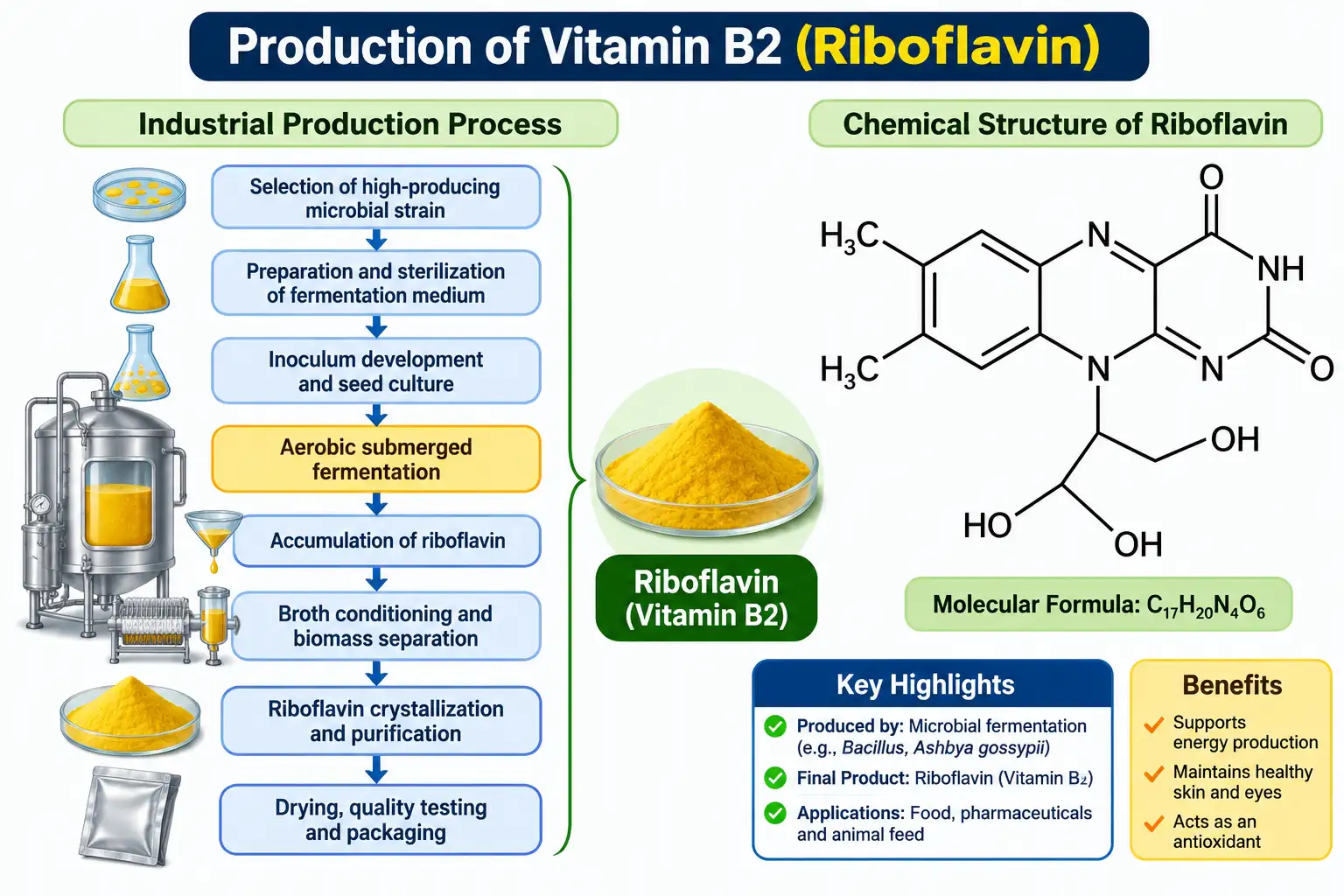
Vitamin B2, commonly known as riboflavin, is a water-soluble vitamin essential for energy metabolism, cellular growth, and numerous oxidation–reduction reactions in living organisms. It acts as the precursor of two important coenzymes, flavin mononucleotide (FMN) and flavin adenine dinucleotide (FAD).
The industrial production of vitamin B2 is mainly carried out through microbial fermentation using high-yielding strains of Ashbya gossypii and Bacillus subtilis. These microorganisms convert suitable carbon and nitrogen sources into riboflavin under carefully controlled aerobic conditions.
Microbial fermentation has become the preferred commercial manufacturing process because it combines high productivity, industrial scalability, and advantages over traditional multistep chemical synthesis.
1. What is Vitamin B2 (Riboflavin)?
Riboflavin belongs to the vitamin B-complex group and is required by humans, animals, plants, and microorganisms for normal cellular metabolism.
- Chemical name: Riboflavin
- Vitamin designation: Vitamin B2
- Molecular formula: C₁₇H₂₀N₄O₆
- Molar mass: Approximately 376.36 g/mol
- Physical appearance: Yellow to orange-yellow crystalline substance
- Solubility: Slightly soluble in water
- Stability: Relatively heat-stable under many conditions but sensitive to light
- Biologically active derivatives: FMN and FAD
Riboflavin contains an isoalloxazine ring connected to a ribityl side chain. Its characteristic yellow colour and fluorescence help distinguish it from many other vitamins.
Biological importance of riboflavin
- It serves as a precursor for FMN and FAD.
- It participates in electron-transfer reactions in cellular respiration.
- It supports the metabolism of carbohydrates, fats, and proteins.
- It contributes to the normal function of flavoprotein enzymes.
- It helps maintain normal cellular growth and physiological function.
Riboflavin deficiency is called ariboflavinosis and may be associated with angular cheilitis, glossitis, and inflammation of oral tissues.
2. Principle of Vitamin B2 Production
The principle of microbial riboflavin production is based on the ability of selected microorganisms to synthesize and accumulate riboflavin in amounts greater than their own metabolic requirements.
Under suitable fermentation conditions, high-producing strains utilize nutrients such as glucose, vegetable oils, nitrogen compounds, and mineral salts to generate riboflavin through their natural biosynthetic pathways.
The process depends on:
- Selection of a stable, high-yielding riboflavin-producing microorganism.
- Preparation of an appropriate nutrient medium.
- Development of an actively growing inoculum.
- Cultivation under controlled aerobic conditions.
- Accumulation of riboflavin in the broth and/or microbial biomass.
- Separation, purification, and drying of the final vitamin product.
3. Microorganisms Used for Riboflavin Production
Several microorganisms are capable of synthesizing vitamin B2, but only selected industrial strains produce it economically at large scale.
| Microorganism | Group | Significance |
|---|---|---|
| Ashbya gossypii | Filamentous fungus | Major established industrial producer |
| Bacillus subtilis | Gram-positive bacterium | Major engineered industrial producer |
| Candida famata | Yeast | Investigated and historically used for high production |
| Eremothecium ashbyi | Filamentous fungus | Natural riboflavin overproducer |
| Escherichia coli | Gram-negative bacterium | Metabolic engineering research |
Note: Ashbya gossypii is also referred to as Eremothecium gossypii in taxonomic literature. It should not be confused with Eremothecium ashbyi.
A. Ashbya gossypii
Ashbya gossypii is a filamentous ascomycete fungus known for naturally producing considerable quantities of riboflavin.
- It develops branching hyphae and filamentous mycelium.
- It produces riboflavin predominantly under aerobic conditions.
- Its fermentation commonly includes an initial growth stage followed by substantial vitamin accumulation.
- Lipids, oils, carbohydrates, and other suitable nutrients may supply carbon.
- Industrial overproduction can be improved by strain selection and metabolic engineering.
B. Bacillus subtilis
Bacillus subtilis is a Gram-positive, endospore-forming bacterium widely studied in industrial microbiology.
- Its natural riboflavin biosynthesis can be enhanced by genetic modification.
- It grows comparatively rapidly under suitable conditions.
- It is suitable for controlled submerged fermentation.
- Engineered strains can channel more metabolic precursors toward riboflavin biosynthesis.
- Its relatively short fermentation cycle offers industrial advantages.
C. Candida famata
Candida famata and related flavinogenic yeasts have also been investigated for riboflavin overproduction.
Although they demonstrate significant biosynthetic potential, industrial competitiveness depends on strain productivity, process stability, and manufacturing economics.
For understanding how production organisms are selected, see Characteristics of Microbes in Industrial Microbiology.
4. Raw Materials and Fermentation Medium
The composition of the fermentation medium plays an important role in determining microbial growth, metabolic activity, and vitamin B2 yield.
A. Carbon sources
Carbon sources supply energy and structural intermediates for riboflavin biosynthesis.
Commonly studied substrates include:
- Glucose
- Sucrose
- Maltose
- Molasses
- Vegetable oils
- Fatty acids
- Other suitable carbohydrate-rich industrial substrates
The preferred substrate depends on the production organism and strain.
For example, industrial B. subtilis processes commonly utilize sugars, whereas A. gossypii can efficiently direct fatty-acid-derived carbon through metabolic pathways contributing to vitamin synthesis.
B. Nitrogen sources
Nitrogen is essential for microbial biomass formation, purine biosynthesis, and the production of nitrogen-containing metabolic intermediates.
Examples include:
- Peptone
- Yeast extract
- Corn steep liquor
- Ammonium salts
- Soybean-derived nutrients
C. Mineral salts
Minerals are necessary for enzyme function, cellular metabolism, and maintaining an appropriate environment.
The medium may include magnesium, phosphate, potassium, sulfur, and other minerals in concentrations optimized for the chosen strain.
D. Growth factors and precursor supplements
Certain formulations may contain compounds such as glycine or purine-related nutrients to improve precursor supply.
However, supplementation does not automatically increase yield; the effects depend on strain metabolism and nutrient balance.
For a detailed explanation of industrial medium design, read Fermentation Media: Composition and Preparation.
5. Industrial Production of Vitamin B2: Step-by-Step Process
The industrial manufacturing process can be divided into three major sections:
- Upstream processing
- Fermentation or bioconversion
- Downstream processing
Flowchart of riboflavin production
Step 1: Selection and improvement of microbial strain
The first step is selecting an efficient organism that can produce riboflavin consistently.
An ideal production strain should have the following characteristics:
- High riboflavin productivity
- Genetic stability
- Rapid and predictable growth
- Ability to utilize economical substrates
- Resistance to process stresses
- Suitable properties for industrial recovery
- Acceptable safety and regulatory characteristics
Industrial strains may be improved through conventional mutagenesis, metabolic engineering, gene regulation, and screening for improved product formation.
Step 2: Preparation of fermentation medium
The selected carbon sources, nitrogen sources, mineral salts, and other nutrients are mixed with water to prepare the production medium.
Before inoculation, the medium and production equipment must be sterilized or appropriately treated to prevent contamination.
Industrial processes may sterilize nutrient groups separately to reduce unwanted heat-induced chemical reactions.
Step 3: Preparation of inoculum
Inoculum preparation involves developing an actively growing and uncontaminated culture of the selected microorganism.
The typical seed development sequence is:
Stock culture → Laboratory seed culture → Seed fermenter → Production fermenter.
A healthy inoculum helps reduce the lag phase and supports reproducible fermentation performance.
Step 4: Submerged aerobic fermentation
The inoculum is introduced into a sterilized fermenter containing the production medium.
During cultivation, the microorganism metabolizes nutrients and synthesizes vitamin B2.
Important controlled parameters include:
- Temperature
- pH
- Dissolved oxygen concentration
- Aeration
- Agitation
- Nutrient feeding
- Foam formation
- Fermentation time
Commercial-scale production generally uses closed, stirred, and aerated fermentation systems with automated monitoring.
Riboflavin production is an aerobic bioprocess. Adequate oxygen is therefore essential, although excessive agitation or unsuitable oxygen-transfer conditions can adversely affect certain strains, particularly filamentous fungi.
Step 5: Riboflavin accumulation
As fermentation progresses, the selected microorganisms direct part of their metabolism toward riboflavin biosynthesis.
Depending on the organism and process, riboflavin may accumulate intracellularly, remain associated with biomass, or be released into the extracellular medium.
The concentration of riboflavin is monitored during production to determine an appropriate harvest point.
Step 6: Harvesting and broth treatment
Once the production target is reached, the fermentation broth is collected for downstream processing.
In processes involving genetically engineered production strains, treatment steps are applied to inactivate viable microorganisms before or during product recovery.
Additional conditioning may facilitate separation and purification.
Step 7: Extraction, recovery and purification
Recovery involves isolating riboflavin from the fermentation mixture.
A general industrial sequence includes:
- Broth conditioning and microbial inactivation.
- Separation of microbial biomass and other solids where appropriate.
- Collection of riboflavin-rich material.
- Concentration or crystallization of the product.
- Washing and purification.
- Additional recrystallization if higher purity is required.
Because riboflavin has limited water solubility, it can form yellow crystalline particles in fermentation broth. Industrial processes exploit this property during recovery.
Step 8: Drying and packaging
Purified riboflavin is converted into a stable powder or granulated product.
The material is subsequently tested for identity, purity, moisture, and compliance with its intended grade and relevant regulations.
Since riboflavin is photosensitive, protection from excessive light is important during handling and storage.
6. Fermentation Conditions for Riboflavin Production
The operating parameters are specific to the organism, strain, and manufacturing technology.
| Parameter | Ashbya gossypii | Bacillus subtilis |
|---|---|---|
| Organism | Filamentous fungus | Bacterium |
| Fermentation type | Aerobic submerged; often fed-batch | Aerobic submerged; often fed-batch |
| Temperature | Approximately 26–30°C | Strain-dependent, commonly near 30–37°C |
| Initial pH | Approximately 6.5–7.5 | Process- and strain-dependent |
| Duration | Approximately 6–8 days in reported industrial processes | Approximately 48–56 hours in a documented industrial process |
| Important feature | Growth and vitamin-accumulation phases | Rapid growth and controlled nutrient feeding |
7. Phases of Riboflavin Fermentation in Ashbya gossypii
For academic understanding, the fermentation of A. gossypii is often described through several physiological stages. The boundaries between these stages are not rigid in every industrial process.
Phase I: Growth phase
- The fungus establishes active mycelial growth.
- Available nutrients are consumed for biomass formation.
- Cellular proteins, enzymes, and other growth-related components are synthesized.
- Organic acid formation may alter the pH of the medium.
Phase II: Transition phase
- Nutrient conditions and cellular metabolism begin to change.
- Growth may slow as regulatory and metabolic pathways shift.
- The culture becomes increasingly favorable for vitamin accumulation.
Phase III: Riboflavin production phase
- Enhanced flux through riboflavin biosynthetic pathways supports product formation.
- Intracellular riboflavin and flavin derivatives contribute to cellular metabolism.
- Increasing amounts of vitamin B2 may become detectable in the culture medium.
Phase IV: Late fermentation and harvest phase
- Riboflavin accumulation approaches its practical maximum.
- Biomass aging or autolysis may occur.
- The broth is harvested at a suitable point to maximize recoverable product while minimizing degradation and processing losses.
The physiological state of the organism, oxygen transfer, nutrient availability, and strain genetics influence the progression of these phases.
8. Biosynthesis of Riboflavin
Riboflavin is synthesized through biochemical reactions involving two major metabolic precursors:
- Guanosine triphosphate (GTP), derived from purine biosynthesis.
- Ribulose-5-phosphate, supplied through the pentose phosphate pathway.
These substrates are converted through a series of enzyme-catalyzed reactions involving modifications of the purine-derived intermediate and formation of a lumazine precursor.
The final ring-forming reaction is catalyzed by riboflavin synthase.
Figure 2. Simplified biosynthesis of riboflavin.
Industrial metabolic engineering increases riboflavin output by improving precursor availability, reducing competing metabolic reactions, and modifying regulatory mechanisms that normally restrict vitamin overproduction.
For more practice with biochemical pathways, explore MCQ on Enzymes and Metabolic Pathways.
9. Factors Affecting Vitamin B2 Production
Several biological and engineering factors influence the final riboflavin yield.
A. Microbial strain
High-producing strains are necessary for commercially useful product concentrations. Strain instability or loss of biosynthetic performance can reduce yield.
B. Carbon concentration
Insufficient carbon can limit growth and product formation. Excess or poorly regulated carbon feeding can cause unwanted metabolic by-products and affect the efficiency of fermentation.
C. Nitrogen availability
Nitrogen influences cell growth and the formation of purine-derived precursors. The optimum carbon-to-nitrogen balance is therefore important.
D. Dissolved oxygen
Riboflavin-producing industrial organisms commonly require substantial oxygen transfer. Inadequate oxygen can restrict metabolism, while process conditions must also preserve appropriate cell morphology.
E. pH and temperature
Both parameters influence enzyme activity, nutrient transport, growth rate, and metabolic flux.
F. Agitation and mixing
Mixing helps distribute nutrients and oxygen throughout the fermenter. For filamentous fungi, agitation can also change mycelial structure and broth viscosity.
G. Fermentation time
Harvesting too early may reduce recoverable riboflavin. Unnecessarily prolonged fermentation increases processing costs and may compromise productivity.
H. Contamination control
Unwanted microorganisms can consume nutrients, alter pH, produce inhibitory metabolites, and compromise product safety or quality.
10. Methods for Improving Riboflavin Yield
Modern biotechnology has introduced several strategies for improving industrial vitamin B2 production.
- Strain selection: Screening microorganisms for high and stable riboflavin accumulation.
- Mutagenesis: Generating and selecting improved variants of established strains.
- Metabolic engineering: Redirecting carbon and nitrogen metabolism toward riboflavin biosynthesis.
- Precursor optimization: Improving the availability of GTP and ribulose-5-phosphate.
- Regulatory modification: Reducing feedback constraints on vitamin production.
- Fed-batch optimization: Controlling nutrient delivery to maintain a favorable metabolic state.
- Oxygen-transfer optimization: Improving aeration and mixing while limiting harmful effects on cell morphology.
- Downstream optimization: Increasing purification efficiency and minimizing product loss.
Research continues into additional microbial hosts, improved strain stability, and lower-cost industrial substrates.
11. Advantages of Microbial Riboflavin Production
- Uses renewable or biologically derived raw materials in suitable processes.
- Reduces dependence on traditional multistep chemical synthesis.
- Supports controlled, scalable manufacturing.
- Can achieve high product concentrations with optimized strains.
- Allows precise optimization through metabolic engineering.
- Produces material suitable for food, pharmaceutical, or feed applications after appropriate purification and quality testing.
The environmental benefits depend on the actual process, including substrate sourcing, energy consumption, water use, and downstream purification.
12. Limitations and Industrial Challenges
Despite its advantages, microbial fermentation has some limitations.
- Maintaining contamination-free production at scale can be challenging.
- Oxygen transfer may limit productivity in large fermenters.
- Filamentous fungal growth can increase broth viscosity.
- High-producing strains may require careful genetic and physiological stabilization.
- Substrate cost influences overall production economics.
- Downstream separation and purification contribute to manufacturing costs.
- Product quality must satisfy relevant specifications, particularly when engineered strains are used.
13. Applications of Vitamin B2
Pharmaceutical and nutritional supplements
Riboflavin is used in vitamin B-complex preparations, nutritional supplements, and formulations intended to prevent or treat riboflavin deficiency.
Food fortification
Vitamin B2 is added to selected food products to enhance their nutritional value and help meet dietary vitamin requirements.
Animal feed industry
Riboflavin is used in feed formulations for poultry, livestock, and other farmed animals to support normal metabolism and growth.
Food colouring and laboratory applications
Riboflavin is also used as food colour E101 where permitted and in laboratory research involving flavoproteins, metabolism, and fluorescence.
14. Difference Between Chemical Synthesis and Microbial Fermentation
| Feature | Chemical synthesis | Microbial fermentation |
|---|---|---|
| Basic principle | Chemical reaction sequence | Microbial biosynthesis |
| Main inputs | Chemical precursors and reagents | Nutrients and microbial cultures |
| Manufacturing | Multiple reaction stages | Integrated biological conversion |
| Sustainability | Depends on chemical process design | Often advantageous with suitable substrates and energy management |
| Strain improvement | Not applicable | Mutagenesis and metabolic engineering |
| Industrial role | Historically important | Dominant modern route |
15. Frequently Asked Questions
Q1. Which microorganism is used for vitamin B2 production?
Ashbya gossypii and engineered strains of Bacillus subtilis are among the most important industrial microorganisms used for riboflavin production.
Q2.What is the fermentation temperature for riboflavin production?
For Ashbya gossypii, commonly reported industrial temperatures are approximately 26–30°C. Other organisms require strain-specific conditions.
Q3. Is vitamin B2 produced by aerobic or anaerobic fermentation?
Industrial vitamin B2 production using major established microorganisms is generally carried out by aerobic submerged fermentation.
Q4. Which precursors are involved in riboflavin biosynthesis?
Guanosine triphosphate (GTP) and ribulose-5-phosphate are two central metabolic precursors.
Q5. What is the difference between riboflavin, FMN and FAD?
Riboflavin is vitamin B2. FMN and FAD are its coenzyme derivatives, which participate in oxidation–reduction reactions.
Q6. Why is Bacillus subtilis preferred in some industrial processes?
Engineered Bacillus subtilis strains offer advantages such as rapid growth, comparatively short production cycles, and established metabolic engineering methods.
16. Conclusion
The production of vitamin B2 (riboflavin) by microbial fermentation is a significant application of industrial microbiology and biotechnology. High-producing strains of Ashbya gossypii and Bacillus subtilis convert nutrients into riboflavin through controlled biochemical processes.
Successful industrial production requires appropriate strain selection, fermentation medium design, aerobic cultivation, metabolic optimization, and efficient downstream recovery.
Advances in strain engineering and fermentation technology continue to improve the productivity and economic efficiency of riboflavin manufacturing.
For additional exam preparation, visit Vitamins and Minerals Quiz: 50 MCQs with Explanations.
Scientific references
- Averianova et al. (2020). Production of Vitamin B2 (Riboflavin) by Microorganisms: An Overview. Frontiers in Bioengineering and Biotechnology.
- Revuelta et al. (2017). Bioproduction of Riboflavin: A Bright Yellow History. Journal of Industrial Microbiology & Biotechnology.
- Production of Riboflavin and Related Cofactors by Biotechnological Processes.
- Biotechnology of Riboflavin.
- Biosynthesis, Regulation, and Biotechnological Production Strategies of Riboflavin.