
Protozoa: Definition and Etymology
The term Protozoa is derived from two Greek words: protos (meaning “first”) and zoon (meaning “animal”). Historically, they were viewed as the most primitive forms of animal life.
Scientific Definition:
Protozoa are a diverse group of unicellular, eukaryotic microorganisms that lack a cell wall and typically exhibit animal-like behaviors, such as motility and heterotrophy (obtaining nutrients by consuming other organisms). While they consist of only a single cell, they are functionally complete organisms capable of performing all vital life processes including digestion, respiration, and reproduction.
Note: In modern taxonomy, “Protozoa” is often used as a descriptive term for animal-like protists rather than a formal kingdom, as molecular evidence shows they are not a single evolutionary lineage.
Key Characteristics of Protozoa
To understand what makes an organism a protozoan, we must look at its structural and functional traits. Below are the core characteristics described in detail:
A. Cellular Structure
Unicellularity: All protozoans are single-celled. However, some species are colonial, where individual cells live together but remain functionally independent.
Eukaryotic Nature: They possess a true nucleus enclosed by a nuclear membrane. They also contain membrane-bound organelles such as mitochondria, Golgi bodies, and lysosomes.
Protoplasm Differentiation: The cytoplasm is usually divided into two distinct zones:
Ectoplasm: The outer, clear, and firm layer that supports the cell membrane and aids in protection.
Endoplasm: The inner, granular, and fluid-like portion containing the nucleus and other organelles.
Pellicle: Many protozoa are covered by a thin, flexible, or rigid layer called the pellicle, which gives the cell a definite shape.
B. Nutrition and Metabolism
Heterotrophic Nutrition: Most are holozoic, meaning they ingest solid organic particles (like bacteria or other protists) through a process called phagocytosis.
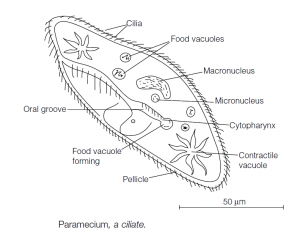
Cytostome: Some advanced protozoans, like Paramecium, have a dedicated “cell mouth” called a cytostome for food ingestion.
Contractile Vacuoles: Fresh-water species possess contractile vacuoles that act as osmoregulators, pumping out excess water to prevent the cell from bursting.
Respiration: Generally occurs through the general body surface via simple diffusion.
C. Locomotion
Protozoa are classified largely based on how they move. They use specialized organelles:
Pseudopodia: “False feet” formed by cytoplasmic streaming (e.g., Amoeba).
Flagella: Long, whip-like structures (e.g., Euglena).
Cilia: Short, hair-like projections that beat in unison (e.g., Paramecium).
Gliding: Some parasitic forms lack obvious organelles and move by gliding.
D. Reproduction
They exhibit both asexual and sexual modes of reproduction:
Binary Fission: The cell divides into two equal halves (most common).
Multiple Fission (Schizogony): The nucleus divides many times before the cytoplasm separates, resulting in many daughter cells (e.g., Plasmodium).
Conjugation: A sexual process in ciliates where two individuals exchange genetic material.
Encystment: Under unfavorable conditions, many protozoa secrete a protective wall to form a cyst, which allows them to survive dehydration or lack of food.
Detailed Classification of Protozoa
The traditional classification of Protozoa, based on the International Society of Protozoologists, divides the phylum into four major sub-groups primarily defined by their mode of locomotion.
Table 1: Comparative Classification of Protozoa
| Sub-group | Locomotory Organelle | Nutrition Type | Reproduction | Key Examples |
| Sarcodina (Amoeboids) | Pseudopodia | Holozoic | Binary Fission | Amoeba, Entamoeba |
| Mastigophora (Flagellates) | Flagella | Holozoic/Autotrophic | Longitudinal Fission | Euglena, Trypanosoma |
| Ciliophora (Ciliates) | Cilia | Holozoic | Conjugation/Fission | Paramecium, Vorticella |
| Sporozoa | None (Sessile/Gliding) | Saprozoic/Parasitic | Multiple Fission | Plasmodium, Monocystis |
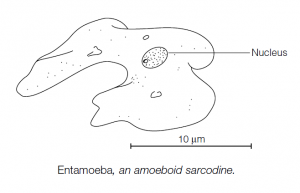
I. Sarcodina (Amoeboids)
Members of this group move and capture food using pseudopodia. They lack a definite shape because their cell membrane is highly flexible.
Habitat: Mostly freshwater, but some are marine or parasitic.
Structure: They may be “naked” (like Amoeba) or have a shell (test) made of calcium carbonate or silica (like Foraminifera).
Example: Amoeba proteus
Found in stagnant freshwater.
Moves using Lobopodia (blunt pseudopodia).
II. Mastigophora (Flagellates)
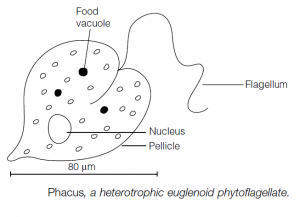
These organisms possess one or more whip-like flagella. This group is unique because it bridges the gap between plants and animals.
Phytoflagellates: Contain chlorophyll and can perform photosynthesis (e.g., Euglena).
Zooflagellates: Lack chlorophyll and are often parasitic (e.g., Leishmania, which causes Kala-azar).
Example: Trypanosoma gambiense
A blood parasite transmitted by the Tsetse fly.
Causes African Sleeping Sickness.
III. Ciliophora (Ciliates)
These are the most complex and highly organized protozoans. They are characterized by the presence of thousands of cilia.
Nuclear Dimorphism: They possess two types of nuclei: a large Macronucleus (controls metabolism) and a small Micronucleus (controls reproduction).
Example: Paramecium caudatum
Commonly known as the “Slipper Animalcule.”
Features a distinct oral groove and a permanent shape.
IV. Sporozoa
All members of this group are endoparasites (living inside a host). They lack specific locomotory organelles in their adult stage.
Life Cycle: Often complex, involving two different hosts.
Pathogenicity: Many cause serious diseases in humans and livestock.
Example: Plasmodium falciparum
The causative agent of Malaria.
Transmitted by the female Anopheles mosquito.
Ecological and Medical Importance
Protozoa play a dual role in the ecosystem and human health:
Decomposers: Soil protozoa break down organic matter, releasing nutrients like nitrogen for plants.
Food Chain: They serve as a vital food source for micro-invertebrates and small fish.
Pathogens: As mentioned, they are responsible for major global diseases including Malaria, Amoebic Dysentery, and Giardiasis.
Waste Treatment: Ciliates are used in sewage treatment plants to consume harmful bacteria and clarify the water.
Frequently Asked Questions (FQC)
Q1: Are protozoa animals?
A: No, protozoa are not animals. They belong to the kingdom Protista. They are called “animal-like” because they move and eat like animals, but they are single-celled, whereas all animals are multicellular.
Q2: What is the main difference between Cilia and Flagella?
A: Cilia are short, hair-like, and usually present in large numbers covering the whole body. Flagella are much longer, whip-like, and usually occur in small numbers (one to four).
Q3: How do protozoa survive harsh conditions?
A: They undergo Encystment. They secrete a thick, resistant wall around themselves, becoming a “cyst.” In this dormant state, they can survive without water or food for long periods until conditions improve.
Q4: Which protozoan is both an autotroph and a heterotroph?
A: Euglena is a classic example. In the presence of sunlight, it performs photosynthesis (autotroph), but in the dark, it hunts for food (heterotroph). This is called Mixotrophy.
Q5: Can we see protozoa with the naked eye?
A: Most are microscopic (10–52 micrometers), but some, like the giant amoeba Chaos carolinense, can reach 5 mm and are visible as tiny white specks.
References & Further Reading
NCERT Biology (Class 11) – Chapter 2: Biological Classification: This is the foundational reference for students in India and abroad, categorizing Protozoa under the Kingdom Protista and detailing the four major locomotory groups.
K.D. Chatterjee (Parasitology: Protozoology and Helminthology): A definitive medical text for understanding the life cycles and pathogenicity of human-infecting protozoa like Plasmodium and Entamoeba.
R.R. Kudo (Protozoology): One of the most comprehensive classic textbooks on the taxonomy and biology of free-living and parasitic protozoa.
Adl et al. (The Revised Classification of Eukaryotes): This research (updated periodically, most recently around 2019) is the modern gold standard for how scientists classify “Protozoa” within the broader tree of eukaryotic life using molecular phylogenetics.
NCBI Medical Microbiology – Protozoa: Structure, Classification, Growth, and Development: A peer-reviewed resource provided by the National Center for Biotechnology Information focusing on the cellular organelles and medical impact of these organisms.
Biology LibreTexts – 9.1: Characteristics of Protozoa: An open-access academic resource detailing reproduction (fission vs. schizogony) and the role of the trophozoite and cyst stages.
AccessScience (McGraw Hill): Provides detailed scientific entries on the morphology, flagellar movement, and colonial behavior of various protozoan phyla.